This case study demonstrates the rigorous planning and execution required for long-haul, international heavy-lift logistics. TLS successfully managed the complex transit of a 110-Metric Ton Pipe Bending Machine from the Hamriyah Freezone in Sharjah, UAE, all the way to Dammam, Saudi Arabia. Spanning 900 kilometers, this cross-border mega-move demanded absolute regulatory compliance, the deployment of professional convoy escorts, and highly strategic road network management across multiple jurisdictions.
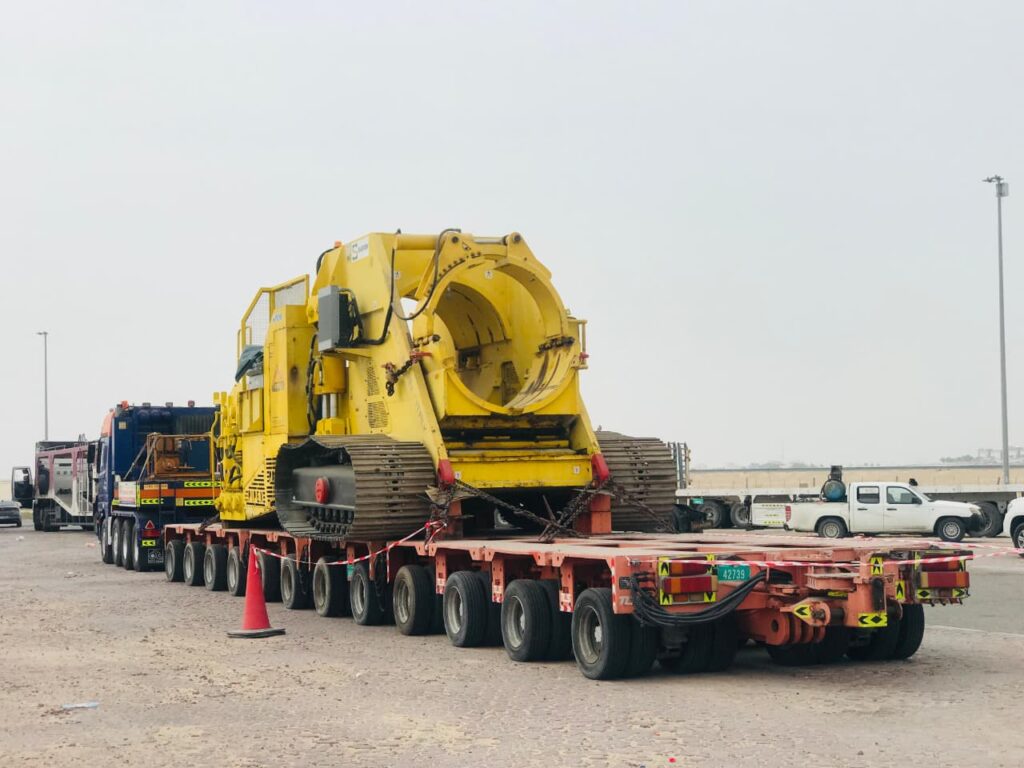
Why is transporting a 110-ton Pipe Bending Machine a major logistical challenge?
Pipe bending machines are indispensable industrial assets for the oil, gas, and construction sectors, utilized to cold-form massive steel pipelines.
Because industrial downtime carries immense financial penalties, the rapid and secure delivery of this equipment is essential to keeping GCC production schedules on track.
Moving a concentrated 110-ton load that stands 4 meters wide and 4 meters tall across 900 kilometers of international highway requires advanced axle-load engineering. Distributing this immense weight properly is critical to protecting public infrastructure and preventing severe delays at border checkpoints.
| Asset Classification | Sector Application | Total Gross Weight | Transit Distance |
| Pipe Bending Machine | Oil & Gas / Pipeline Fabrication | 110 Metric Tons | 900 Kilometers (Cross-Border) |
Exact Project Specifications:
- Overall Length: 10,670 mm (10.67 meters)
- Overall Width: 4,000 mm (4.00 meters)
- Overall Height: 4,000 mm (4.00 meters)
- Origin to Destination: Hamriyah Freezone (Sharjah, UAE) to Dammam (KSA)
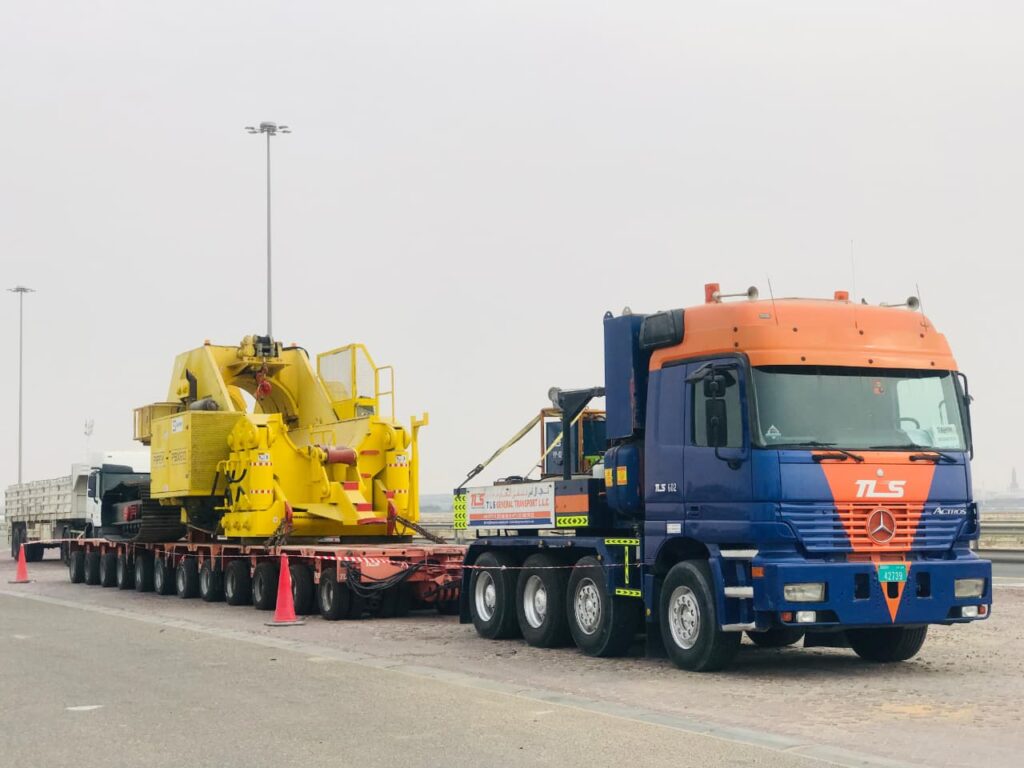
How did TLS execute a 900-kilometer cross-border transit?
Boasting a 4-meter width and height profile, the cargo was strictly classified as Over-Dimensional Cargo (ODC) under both UAE and KSA federal traffic laws. Because the machinery drastically exceeded standard highway lane limits, conventional routing was impossible.
To guarantee a safe, uninterrupted journey through highly congested emirates and across international borders, TLS engineered a multi-jurisdictional transit strategy.
Core operational solutions provided by TLS:
- Strategic UAE Road Openings: Navigating the strict traffic regulations of the UAE required meticulous coordination with local police to secure “road openings” across three distinct emirates:
- Sharjah: Successfully navigated the initial leg via Al Dhaid Road (E88).
- Dubai: Bypassed severe urban congestion by transitioning through the Dubai-Al Ain Road (E66) onto Emirates Road (E611).
- Abu Dhabi: Secured safe passage via Sweihan Road (E20) and Al Ain Road (E22), eventually merging onto the Sheikh Khalifa Bin Zayed Al Nahyan International Road (E11) toward the Saudi border.
- Seamless KSA Cross-Border Compliance: Transporting ODC into the Kingdom of Saudi Arabia requires flawless customs documentation. TLS preemptively secured all mandatory international heavy-lift permits long before the convoy reached the border, completely neutralizing the risk of costly delays.
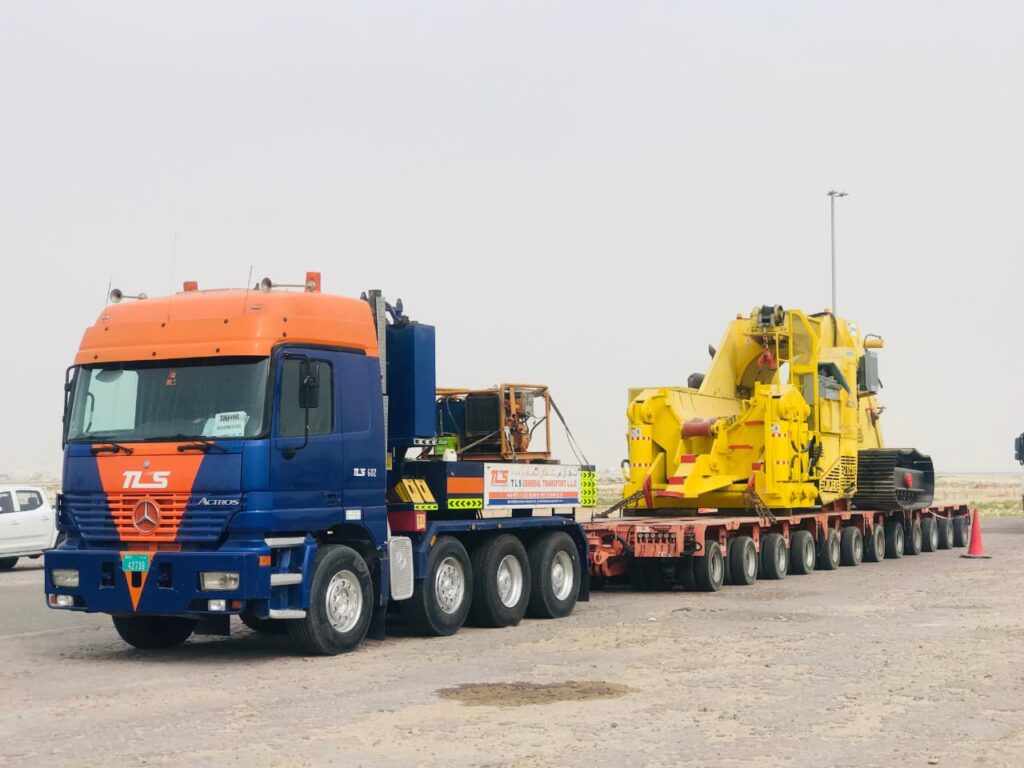
- Professional Convoy Escorts: Across both the UAE and KSA segments, TLS deployed specialized escort vehicles. These teams actively managed civilian traffic flow, guided the heavy-lift trailer through narrow physical clearances, and ensured total safety for both the public and the high-value cargo.
Measuring the Mega-Move: Project Success Metrics
The true measure of a 900-kilometer international heavy-lift operation is the seamless transition of the cargo through diverse regulatory environments with zero incidents.
| Logistical Challenge | Project Constraint | TLS Execution Strategy |
| Cross-Border Transit | 900 km UAE to KSA route | Proactively managed all international customs and heavy-lift permitting. |
| Regulatory Compliance | Strict UAE & KSA traffic mandates | Orchestrated multi-emirate road openings (E88, E611, E11) with local police. |
| Traffic Management | 4.0-Meter ODC width | Maintained continuous professional escort security across both nations. |
| Supply Chain Continuity | Critical Oil & Gas asset | Delivered the 110-ton machine safely to sustain GCC fabrication schedules. |
This project reinforces the elite capabilities of TLS in managing complex, long-haul supply chains across the Middle East. Driven by engineering excellence, regulatory foresight, and a strict commitment to operational safety, TLS guarantees that the heaviest industrial equipment reaches its destination on time, every time.
Frequently Asked Questions on Cross-Border ODC Logistics
Q: What are “strategic road openings” and why are they needed for a 4-meter wide load?
Standard highway lanes in the UAE are engineered for vehicles up to roughly 2.6 meters wide. A 4-meter-wide industrial machine physically occupies multiple lanes. A strategic road opening involves TLS coordinating with highway police to create a “moving bubble,” temporarily restricting standard traffic to allow the oversized convoy to pass safely without risking civilian collisions.
Q: What is legally required to move heavy ODC cargo from the UAE into Saudi Arabia?
Cross-border heavy-lift logistics requires immense administrative groundwork.
It mandates dual-country physical route surveys, the acquisition of specialized Ministry of Transport permits from both the UAE and KSA, intricate border customs clearance for high-value assets, and the seamless handover of police escort protocols at international checkpoints like the Al Batha border.
Q: Why does a relatively short Pipe Bending Machine weigh 110 tons?
While only 10.67 meters long, these machines are incredibly dense. They are constructed from massive, solid steel blocks and house immense hydraulic systems. This extreme density is required to generate the incredible mechanical force needed to cold-bend the thick steel pipelines utilized in the global oil and gas sector, pushing the total weight to a staggering 110 metric tons.