
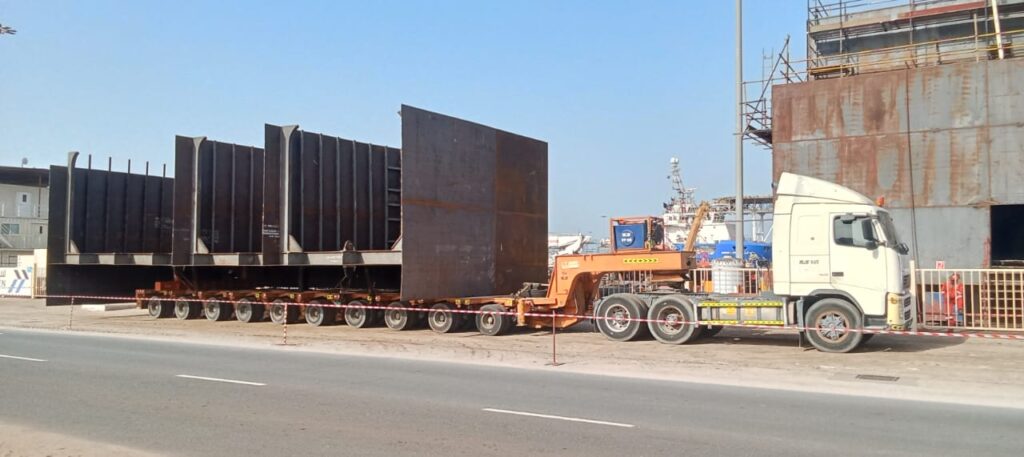
This case study illustrates TLS’s unmatched capacity to execute multi-unit, Over-Dimensional Cargo (ODC) campaigns across the United Arab Emirates. Our heavy-lift specialists successfully managed the complex transit of four colossal Barge Blocks from a manufacturing yard in Umm Al Quwain directly to Khalifa Port in Abu Dhabi. Transporting marine components spanning nearly 8 meters wide and over 5.4 meters tall necessitates a highly engineered logistics framework, utilizing advanced multi-axle hydraulic transport and rigorous inter-emirate route planning.
Why does transporting oversized Barge Blocks require advanced logistics expertise?
Barge blocks are massive, prefabricated steel sections that are later welded together to form a vessel’s hull.
Because they are built for the ocean, moving them by road is an immense logistical undertaking. At 7,900 mm (7.9 meters) wide, a single block engulfs more than two standard highway lanes. Furthermore, a towering running height of 5,480 mm (5.48 meters) transforms routine highway overpasses into impassable roadblocks, demanding extreme route customization.
| Asset Classification | Transit Corridor | Unit Gross Weight | Maximum Width |
| Prefabricated Barge Blocks | Umm Al Quwain to Khalifa Port | 60 Metric Tons (per unit) | 7,900 mm (7.9 m) |
Exact Project Specifications:
- Unit Length: 16,000 mm (16.0 meters)
- Unit Width: 7,900 mm (7.9 meters)
- Unit Height: 5,480 mm (5.48 meters)
- Total Volume: 4 Individual Blocks
What heavy-lift equipment safely managed the 7.9-meter-wide marine cargo?
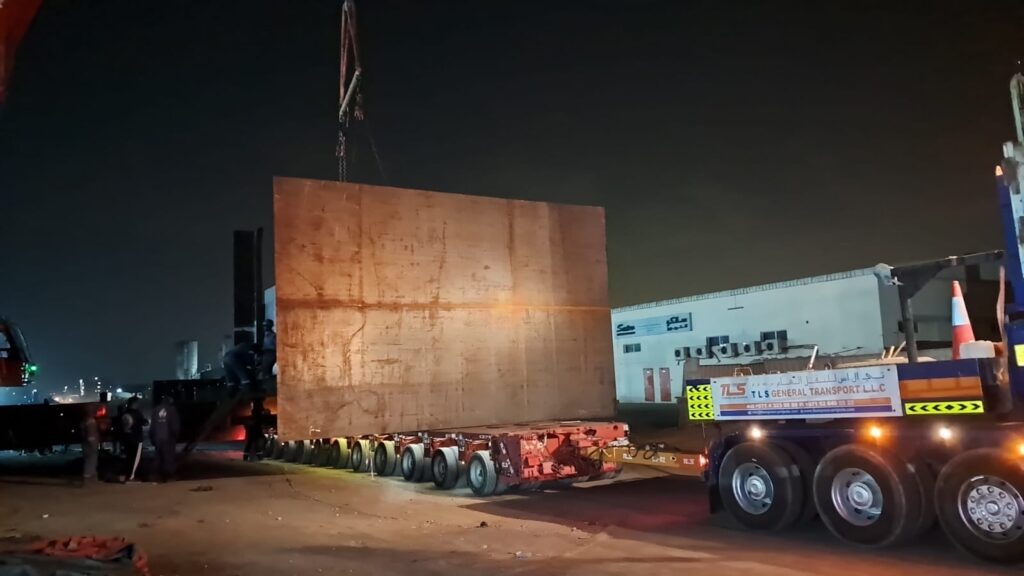
Conventional flatbed trailers lack the structural deck space and the suspension required to stabilize a 60-ton load with such an extreme width and high Center of Gravity (CoG). To guarantee absolute stability across the long-haul transit, TLS deployed a fleet of Multi-Axle Hydraulic Trailers.
The independent hydraulic suspension on these specific trailers was the critical factor in keeping the massive hull sections perfectly horizontal, even when the convoy encountered uneven terrain or steep road gradients.
Core operational solutions provided by TLS:
- Active Hydraulic Leveling: The designated route featured steep inclines, which normally introduce a severe tipping hazard for tall cargo. TLS operators actively manipulated the hydraulic axles to counteract the road’s slope, keeping the trailer deck and the 60-ton load perfectly flat.
- Extreme Width Accommodations: Because the 7.9-meter width drastically overhung the standard trailer bed, TLS engineers installed heavy-duty widening kits and custom dunnage arrays to fully support the structural integrity of the blocks.
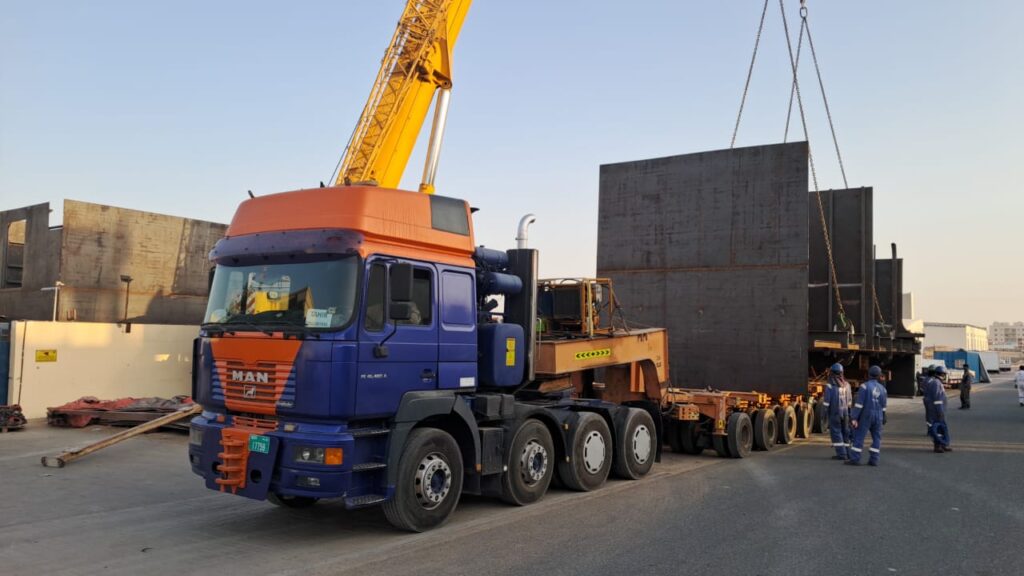
- Convoy Orchestration: Safely moving four of these mega-structures simultaneously required a synchronized convoy. TLS deployed professional pilot vehicles to secure the road ahead and control civilian traffic flow around the rolling blockade.
How did TLS overcome the inter-emirate transit challenges?
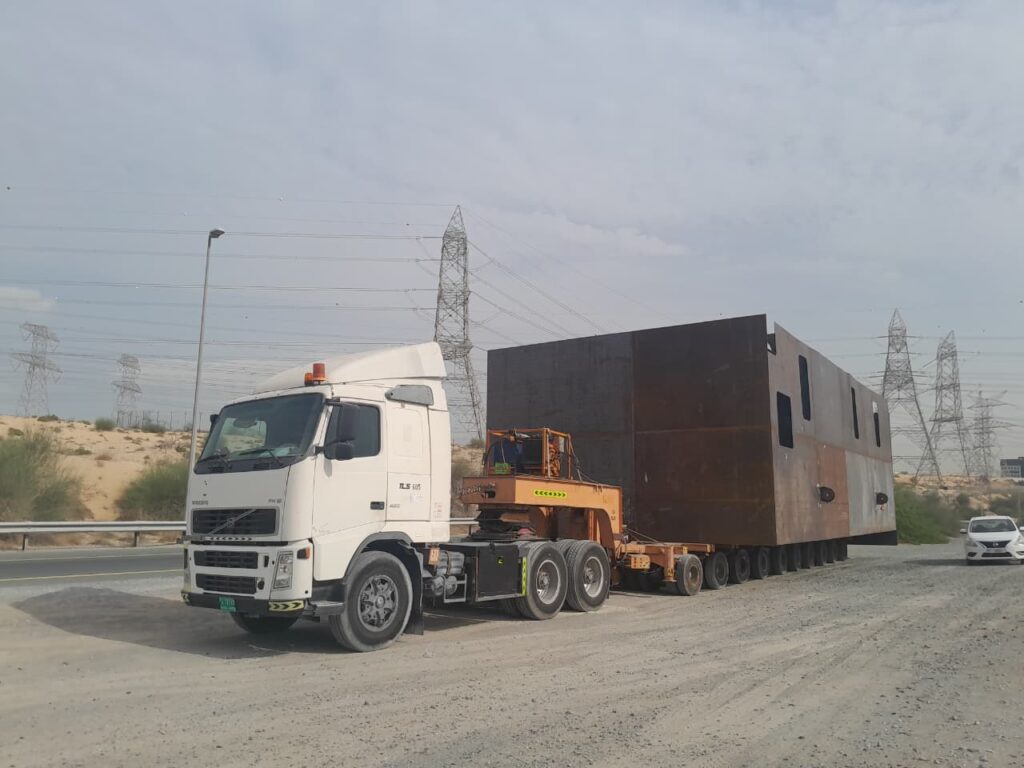
Moving from the Northern Emirates to the capital is a long-haul journey that crosses four distinct regulatory jurisdictions: Umm Al Quwain, Sharjah, Dubai, and Abu Dhabi.
| Logistical Challenge | Project Constraint | TLS Execution Strategy |
| Route Geometry | Narrow passages & steep inclines | Utilized active hydraulic suspension to prevent tipping on gradients. |
| Regulatory Borders | Crossing 4 distinct UAE Emirates | Secured unified, cross-border ODC movement permits from all authorities. |
| Vertical Clearance | 5.48-Meter cargo height | Mapped an intricate route utilizing service roads to bypass low bridges. |
| Load Security | High Center of Gravity | Executed strict lashing engineering to ensure zero shift of the 60 MT blocks. |
This multi-unit project reinforces TLS’s position as a premier leader in complex ODC execution. By successfully delivering these vital marine components to Khalifa Port without delay or incident, we ensured the client’s wider barge assembly schedule proceeded exactly as planned.
Frequently Asked Questions on Marine ODC Logistics
Q: Why is a 7.9-meter width a major hazard on UAE highways?
A standard UAE highway lane measures approximately 3.65 meters across. A 7.9-meter piece of cargo occupies roughly two and a half lanes. This essentially turns the transport convoy into a “rolling roadblock.” To move it safely without causing accidents, logistics providers must coordinate police escorts, execute rolling road closures, and physically remove roadside obstacles like traffic signs or safety barriers along the route.
Q: How do heavy-lift convoys bypass low highway bridges?
When cargo stands 5.48 meters high, it physically cannot pass beneath most standard highway overpasses. Instead of going under, TLS route engineers map out bypasses. This often involves taking the off-ramp to exit the highway, crossing the intersecting surface street, and immediately taking the on-ramp back onto the highway to successfully bypass the bridge structure.
Q: What makes steep inclines dangerous for a 60-ton load?
When a heavy, tall object navigates up or down a steep slope, its Center of Gravity shifts dramatically.
[Image demonstrating the center of gravity shift on a steep incline for tall heavy cargo]
If the road angle becomes too severe, the load’s weight can pull it off balance, causing it to slide off the deck or tip the entire trailer over. Hydraulic trailers neutralize this threat because operators can physically lift the “downhill” side of the trailer deck, keeping the cargo level regardless of the road’s angle.